Article: Commercial Fire Pit and Fire Table Specifications: A Hospitality Procurement Guide
Commercial Fire Pit and Fire Table Specifications: A Hospitality Procurement Guide
When you're outfitting a hotel pool deck, restaurant patio, or event venue with fire tables, the specifications matter more than they do for a residential purchase. You're considering guest safety, code and certification requirements, daily wear from high-traffic use, and how quickly your maintenance team can turn a space around between events.
For most commercial fire table projects, the key specifications to evaluate are fuel type, BTU output, ignition and safety controls, certification, construction, and mobility. Getting these decisions right at the procurement stage can prevent installation problems, operational headaches, and unexpected maintenance costs later.
This guide covers the specifications hospitality and commercial buyers should evaluate before placing an order.
Commercial Fire Table Specifications at a Glance
|
Specification |
What to Determine |
Why It Matters |
|
Fuel type |
Natural gas or LP |
Determines installation requirements, operating logistics, and mobility |
|
BTU output |
Required heat and flame output |
Should be appropriate for table size, seating area, and environmental conditions |
|
Ignition system |
Electronic, battery-powered, flame-sensing, or manual |
Affects operation, safety, infrastructure, and staff procedures |
|
Safety controls |
Flame sensing, emergency shutoff, E-stop, lockout, etc. |
Important for commercial operation and risk management |
|
Certification |
Applicable product listing/certification |
May be required for permitting, insurance, and project approval |
|
Mobility |
Fixed installation or commercial casters |
Determines how easily the space can be reconfigured |
|
Construction |
Stainless steel, aluminum, powder-coated materials, etc. |
Affects durability and long-term maintenance |
|
Warranty |
Commercial-specific warranty terms |
Helps establish expected service life and total cost of ownership |
|
Lead time |
Standard vs. customized production |
Important for property openings, renovations, and seasonal launches |
1. Fuel Type and Size: Matching Output to Your Space
The first decision in any commercial fire table order is fuel type, and it shapes almost everything downstream — installation cost, ongoing operating expense, and where the table can go.
Natural gas is often the preferred choice for permanent installations such as hotel pool decks and restaurant patios with existing gas infrastructure. It eliminates tank swaps, which matters when a property has a dozen or more tables running every evening. The trade-off is that the table is tied to a gas connection, so placement is generally permanent unless the installation incorporates appropriate quick-disconnect equipment.
Liquid propane (LP) provides greater flexibility. Tables can be repositioned for private events, seasonal layouts, or renovations without depending on a permanent gas line. Commercial LP fire tables may use standard portable cylinders housed in the base, while larger installations can use remote tanks with a regulated feed line to reduce refill frequency.
How many BTUs does a commercial fire pit need?
BTU output should be evaluated in relation to the size and design of the fire feature, seating area, wind exposure, ambient conditions, and desired flame performance.
Residential fire tables often operate in the 30,000–50,000 BTU range. For larger commercial installations, higher-output systems may be appropriate. As a general starting point, hospitality applications may call for approximately 60,000–80,000 BTUs for standard seating areas, with larger or more exposed installations potentially requiring 100,000+ BTUs.
These figures should be treated as planning ranges rather than universal requirements. The appropriate output depends on the specific burner, table dimensions, installation environment, and applicable requirements.
It's also important to avoid specifying output based solely on BTUs. Burner design, flame distribution, wind exposure, and the distance between the burner and guests all affect the perceived performance of a fire feature.
2. Commercial Fire Pit Ignition & Control Systems
Control systems distinguish a fire feature designed for occasional residential use from one intended to operate frequently in a hospitality environment with rotating staff and guests nearby.
When evaluating an ignition system, consider four questions:
-
How will staff start and stop the fire feature?
-
What happens if the flame is extinguished unexpectedly?
-
Is electrical service available at the installation location?
-
Does the system provide the controls required by the project, property, and applicable regulations?
All Weather Electronic Ignition Systems (AWEIS)
All Weather Electronic Ignition Systems (AWEIS) are designed for installations where electrical service is available and the fire feature will be operated frequently.
An AWEIS can typically be integrated with external controls such as a light switch, timer pedestal, or other electrical switching system, depending on the specific system configuration. For hospitality installations, this can make operation easier to standardize across multiple fire features.
AWEIS systems should be evaluated based on the specific product's capabilities, certification, installation requirements, and compatibility with the fire feature.
Timer Pedestals, E-Stops, and Lockouts
For common-area fire features, a timer pedestal or external control system can provide centralized or controlled operation. Emergency-stop and lockout functionality can also be incorporated where required by the installation.
Cooke timer pedestals are available in commercial-grade construction, including powder-coated steel and stainless-steel configurations, with custom options available for different projects.
The appropriate control configuration depends on the fire feature, site design, electrical system, and operational requirements.
Battery-Powered Electronic Ignition Systems
Battery-powered all-weather electronic ignition systems (BP-AWEIS) can be considered where electrical service isn't readily available.
The main advantage is reduced dependence on a permanent electrical connection. However, battery-powered systems introduce additional considerations around battery life, maintenance, reliability, and operating conditions.
For a high-use hospitality installation, buyers should evaluate the specific system's operating history and maintenance requirements rather than assuming a battery-powered system will perform identically to a hardwired installation.
Flame-Sensing Manual Valves
Flame-sensing manual valves, including thermocouple-based systems, can provide flame-loss protection without requiring a permanent electrical connection.
These systems are commonly paired with a push-button sparker for ignition. They may be appropriate where electrical infrastructure isn't available, although they generally require more direct staff operation than an electronic ignition system.
Manual Key Valves
A manual key valve is a simple and widely used control option for fire pits and fire features. It requires manual ignition, often with a handheld lighter or other approved ignition method.
Because operation and safety behavior depend heavily on the specific valve and system configuration, commercial buyers should confirm the applicable safety features, certification, operating procedures, and supervision requirements before selecting a manual system.
Manual Push-to-Turn Valves
A manual push-to-turn valve operates similarly to a familiar stovetop or barbecue control. It is another relatively simple option for staff-operated fire features.
When evaluating any manual valve for a commercial installation, confirm that the specific valve and completed fire-feature assembly have the appropriate certification or listing for the intended application.
3. Certification, Codes & Documentation
Certification and documentation should be addressed early in the procurement process rather than after the fire tables arrive on site.
The requirements for a commercial fire feature can vary depending on the equipment, fuel type, installation, jurisdiction, and project. Before ordering, buyers should identify what their authority having jurisdiction (AHJ), project engineer, property risk manager, or insurer will require.
Depending on the project, useful documentation may include:
-
Product certification or listing information
-
Installation instructions
-
Gas requirements and connection specifications
-
Electrical requirements
-
Burner and valve specifications
-
Ignition and safety-system documentation
-
Commercial warranty terms
-
Maintenance requirements
-
Replacement-parts information
-
Insurance documentation such as a Certificate of Insurance
Don't assume that a certification or listing applicable to one configuration automatically applies to every installation. Confirm that the specific fire feature, fuel configuration, ignition system, and intended application meet the requirements of the project.
For hospitality procurement teams, getting this documentation before the purchase order is finalized can help prevent delays during permitting, installation, insurance review, or property approval.
4. Commercial-Grade Fire Pit Tables with Wheels: Built for Mobility
For venues that reconfigure space regularly — banquet rooms, poolside event lawns, rooftop bars, and seasonal patios — mobility is an important specification.
This is where commercial-grade fire pit tables with wheels can provide a significant operational advantage.
The key specification isn't simply whether a table has wheels. It's the quality and rating of the entire caster and base assembly:
-
Locking casters rated for the expected commercial load, so tables stay stationary during service and move only when staff intend to relocate them.
-
Load-rated wheel assemblies capable of handling the combined weight of the table base, fuel tank, and stone or concrete top.
-
Frame material such as stainless steel or powder-coated aluminum, which can provide greater durability than residential-grade steel when tables are repeatedly moved across concrete, pavers, or pool decking.
-
Surface protection on the underside of the base to help prevent scuffing or damage to flooring during relocation.
Fire tables on commercial locking casters give hospitality operators the ability to reconfigure a patio for a private event and restore the standard layout afterward without relying on a forklift or large maintenance crew.
Case Study: Four Years of Daily Use at a Disneyland-Area Hotel
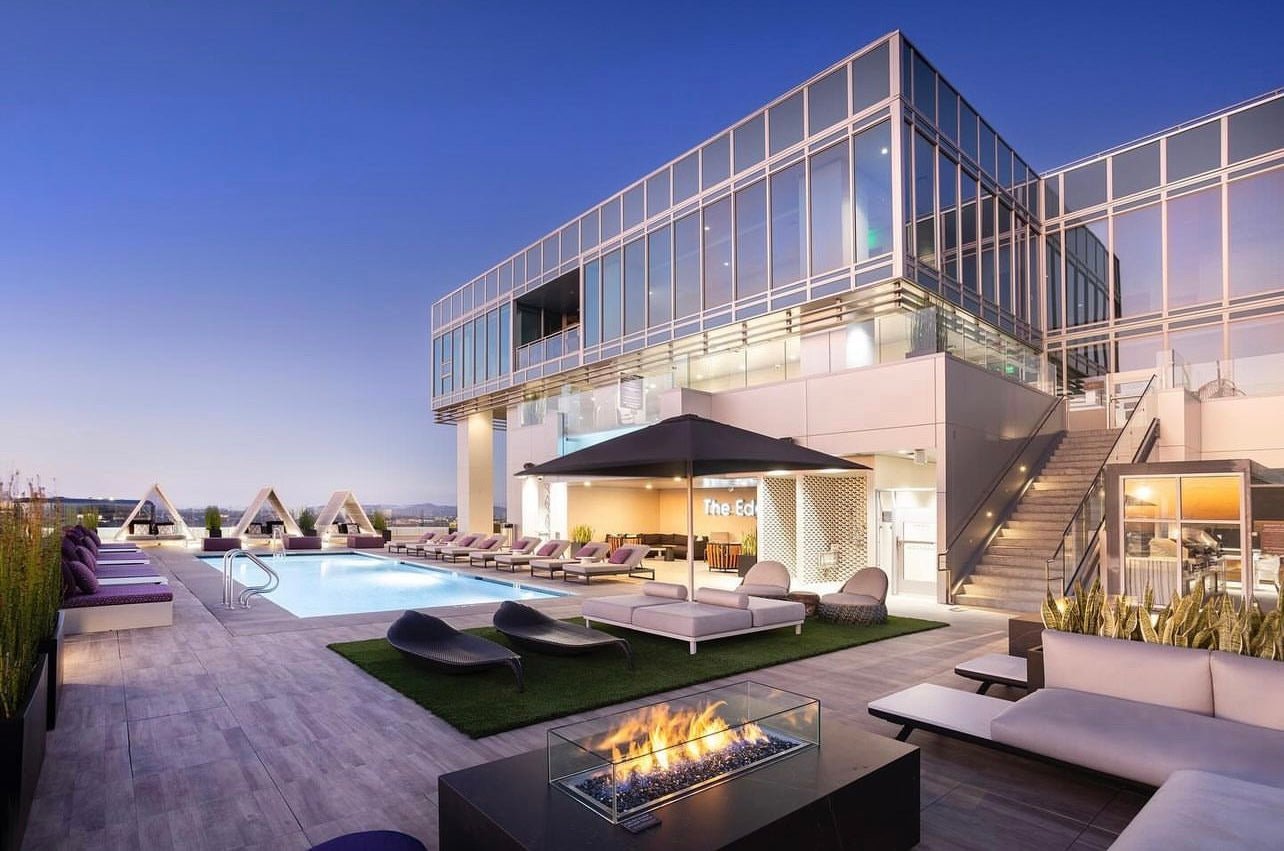
We supplied a set of 4 commercial fire tables with locking casters to a hotel located next to Disneyland, and the property has now been running them for about four years. On a recent site visit, the results were exactly what we hope to see in every commercial installation:
-
The tables are still running as designed, with no meaningful degradation in ignition or flame performance.
-
The locking casters have held up to nightly use and periodic layout changes for the hotel's event programming, with no wheel failures or frame cracking.
-
Housekeeping and grounds staff reported the mobility feature gets used regularly — tables get rolled aside for deep cleaning, pool maintenance, and to open up space for larger group events.
-
The hotel's team specifically called out how little maintenance the tables have required relative to expectations for a high-traffic tourist-adjacent property.
It's a useful data point for procurement teams evaluating total cost of ownership: a fire table specified correctly for commercial use — with appropriate BTU output, ignition and safety controls, and commercial-grade locking casters where mobility is needed — can run daily for years in a high-traffic hospitality environment without becoming a maintenance liability.
Questions Hospitality Procurement Teams Ask Us Most
Is there a difference between residential and commercial warranty coverage?
Yes — many manufacturers offer separate commercial warranty terms because daily-use wear patterns are different from occasional residential use. Always ask specifically for the commercial warranty terms before ordering, rather than assuming the standard consumer warranty applies.
What's the lead time for a multi-table commercial order?
Lead times are typically 10–12 weeks, although they can vary based on order volume and customization, including finish, fuel type, and caster configuration. Request a timeline as soon as you have a rough table count, especially if you're working toward a property opening or seasonal launch date.
How much maintenance should we budget for?
At minimum, plan for periodic burner and ignition checks, seasonal cover use in wet or coastal climates, and caster inspection if tables are rolled frequently. Commercial-grade units are designed to minimize maintenance, but a basic inspection and maintenance schedule should still be part of your operations plan. Maintenance programs for fire pits and fire features in Southern California start at $300 per visit.
Can tables be moved between natural gas and propane later, or between locations on a property?
Cooke fire pit tables have conversion kits available for changing gas types on applicable models. However, gas conversion should be evaluated based on the specific model and installation rather than assumed to be universally available. Propane generally offers greater flexibility for locations that may be reconfigured because the table isn't tied to a permanent gas line.
What certifications and documentation should we request?
Ask for the product's applicable certification or listing information, installation documentation, safety-system specifications, commercial warranty terms, and any other documentation required by your project, insurer, or authority having jurisdiction.
Do you provide documentation for insurance and risk management review?
Yes. We can provide a Certificate of Insurance for commercial installations, along with applicable certification documentation, safety-system specifications, and commercial warranty information.
Getting the Spec Right the First Time
Fire tables are a long-term fixture for most hospitality properties, not a seasonal purchase — which is exactly why the specification phase matters.
Start with the fundamentals: fuel type, BTU output, ignition and safety controls, applicable certification, construction, and mobility requirements. Then confirm the documentation, warranty, maintenance requirements, and lead time before placing the order.
Whether you're specifying a single fire table for a boutique property or a larger installation across a rooftop, restaurant patio, or pool deck, getting these decisions right upfront can save your team significant time and expense later.
Our commercial team can help you match fire table specifications to your venue and provide the certification, warranty, and project documentation your procurement and risk teams need.