Commercial Fire Table Materials: Stone vs. Porcelain vs. GFRC vs. Concrete
The material of a commercial fire table's tabletop and base affects its weight, durability, maintenance requirements, appearance, and suitability for different climates.
There is no single best material for every application. The right choice depends on the property's climate, aesthetic goals, mobility requirements, and how much maintenance the team can realistically commit to.
Here’s how the four most common commercial fire table materials compare: natural stone, porcelain, GFRC, and poured or cast concrete.
Material Comparison
|
Material |
Weight |
Maintenance |
Weather Performance |
Mobility |
Best Fit |
|
Natural Stone |
Heavy |
Moderate–High |
Good with maintenance |
Limited |
Premium properties |
|
Porcelain |
Moderate |
Low |
Excellent |
Good |
High-traffic and coastal properties |
|
GFRC |
Light |
Moderate |
Good with proper sealing |
Excellent |
Custom and mobile installations |
|
Poured Concrete |
Very Heavy |
Moderate–High |
Good with maintenance |
Poor |
Permanent architectural installations |
Actual performance depends on the specific material, fabrication, sealant, fire table construction, climate, and maintenance program.
Natural Stone
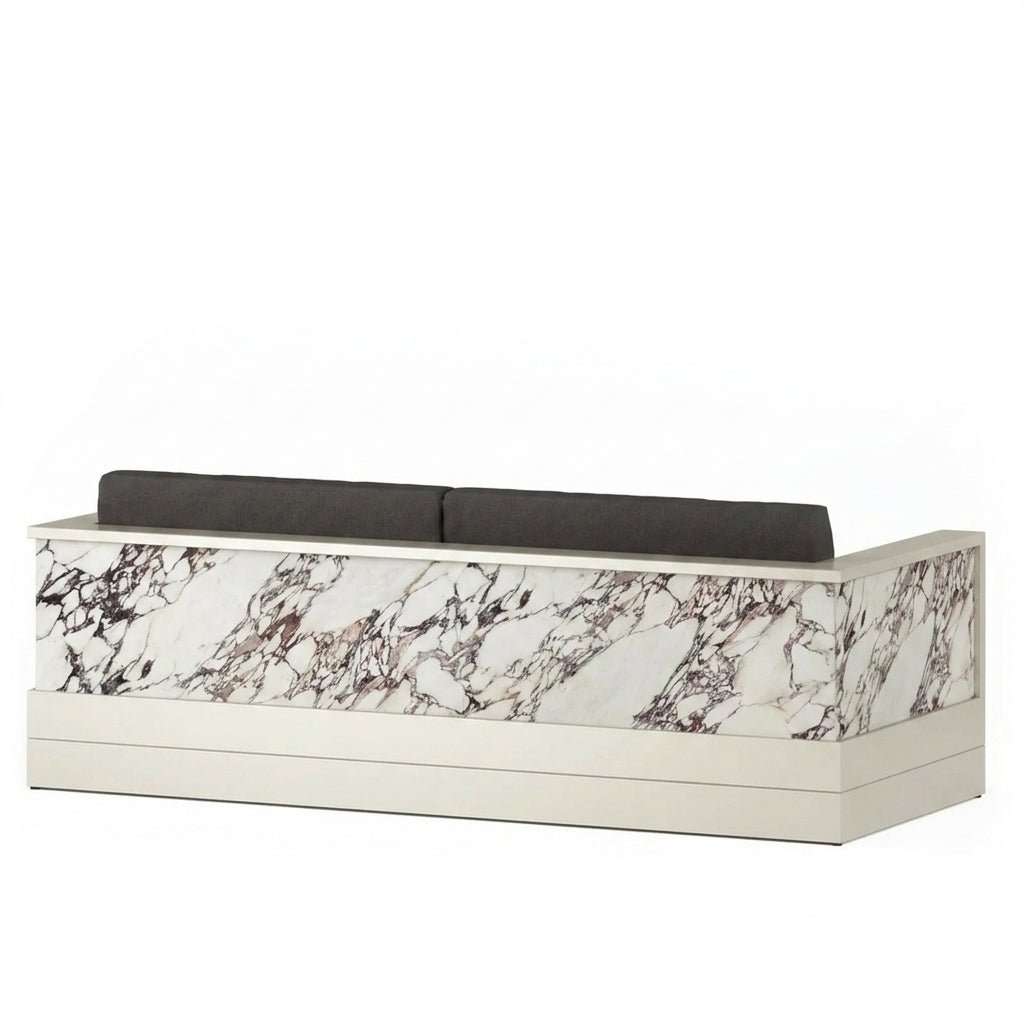
Natural stone, including granite, marble, and quartz, is the traditional premium choice for commercial fire tables. No two slabs are exactly alike, making it particularly appealing for high-end hospitality environments where authentic natural materials are part of the design.
Natural stone is generally heavy and can be porous, depending on the specific stone. Periodic sealing may be necessary to resist staining and moisture absorption. Weight is also an important consideration if the fire table will be mounted on locking casters; the caster load rating should be based on the finished table weight, not just the base.
In freeze-thaw climates, proper material selection, fabrication, drainage, and sealing are particularly important because moisture entering porous material can contribute to cracking as temperatures fluctuate.
Natural stone is best suited to properties where premium aesthetics and authentic material are more important than minimizing weight or maintenance.
Porcelain
Porcelain has become a popular alternative to natural stone for commercial outdoor fire tables, particularly where low maintenance and weather resistance are priorities.
Exterior-rated porcelain has very low water absorption, making it highly resistant to staining and moisture penetration. It is also available in products designed for outdoor environments, with resistance to UV exposure and freeze-thaw conditions.
For commercial properties, the low-maintenance nature of porcelain can be a significant advantage. The surface generally requires little more than routine cleaning, without the regular sealing associated with many natural stone and concrete surfaces.
Porcelain is available in a wide range of colors, textures, and stone-look patterns, giving designers considerable flexibility. The trade-off is that even high-quality digitally printed porcelain may not replicate the unique variation and movement of genuine quarried stone. Porcelain can also chip from hard impacts, and repairs may be more visible than repairs to some natural stone surfaces.
Porcelain is particularly well suited to high-traffic patios, pool decks, and coastal properties where minimizing maintenance is a priority.
GFRC (Glass Fiber Reinforced Concrete)
GFRC, or Glass Fiber Reinforced Concrete, is widely used for modern fire tables because it combines relatively low weight with extensive design flexibility.
Because GFRC is cast rather than quarried, manufacturers can produce custom colors, textures, shapes, and edge profiles that would be difficult or expensive to achieve with natural stone. It also weighs significantly less than traditional poured concrete, which can be a major advantage for tables that need to be moved, transported, or shipped.
The main consideration is manufacturing quality. Well-made GFRC with appropriate fiber content, wall thickness, fabrication, and sealing can provide years of service, while poorly manufactured or inadequately sealed GFRC may be more susceptible to hairline cracking and moisture absorption.
GFRC is a strong option for design-forward hospitality projects where customization and lower weight are important.
Poured or Cast Concrete
Poured or cast concrete is the heaviest and most substantial of the four materials. It is often selected for permanent installations where the fire table is intended to function as an architectural element rather than a movable piece of furniture.
Concrete provides extensive flexibility in color, texture, shape, and finish. Like many natural stone products, however, concrete is porous and typically requires sealing to help prevent staining and moisture absorption.
Its weight is the primary limitation for mobile applications. A concrete fire table can place significant demands on casters, flooring, and staff when it needs to be moved regularly. If mobility is a priority for the venue, a lighter material such as GFRC or porcelain may be a better fit.
Concrete is best suited to permanent installations where substantial weight is acceptable and the architectural appearance is a primary consideration.