

The Complete Guide to Installing Luxury Outdoor Fire Pits: What Trade Professionals Need to Know
Key Takeaways
- Premium Materials Deliver Performance: Luxury fire pits use 304/316 stainless steel, GFRC, and brass burners with electronic ignition systems (including safety shut-offs). These deliver 150,000-300,000+ BTUs, significantly higher than the standard 25,000-50,000 BTU models.
- Clearance Codes Vary by Jurisdiction: Maintain a minimum of 36 inches clearance from side walls and 8 feet clearance from ceiling. For gas-fueled devices, ensure that the minimum clearance for combustible materials is adhered to, with specific guidelines for wood-burning units.
- Gas Line Sizing Determines Performance: ¾-inch lines at 60 feet supply a maximum of 138,000 BTUs; 1-inch lines at 125 feet deliver 175,000 BTUs. Proper sizing prevents low flame height and ensures optimal operation.
- Fire Pits Yield 67-78% ROI: Professional installations deliver measurable returns, with properties selling 4% faster and commanding 5-12% price premiums. Natural gas units with proper marketing can achieve 80-100% ROI.
- Professional Installation Protects Investments: Licensed installers ensure code compliance, warranty qualification, and safety certification, while preventing costly callbacks from improper gas connections, inadequate ventilation, or clearance violations
Luxury outdoor fire pits offer one of the highest ROI for outdoor features trade professionals can install, delivering 67-78% returns while commanding premium pricing in competitive markets. This comprehensive guide covers everything contractors, landscape architects, and installers need to know—from material specifications and BTU requirements to safety codes, gas line installation, and troubleshooting common challenges.
Understanding clearance regulations, certification standards, and professional installation protocols ensures code compliance, warranty qualification, and long-term performance. Whether you're specifying fire pits for residential estates or commercial hospitality projects, this guide provides the technical knowledge and best practices that separate professional installations from amateur work, protecting your reputation while maximizing client satisfaction and project profitability.
What Are Luxury Outdoor Fire Pits and Why Are They Essential for Outdoor Living?
Luxury outdoor fire pits separate high-end properties from average properties, enhancing user experience through premium materials, precision engineering, and certified safety standards. These high-end features deliver measurable ROI while creating year-round gathering spaces that command premium pricing in competitive markets.
What Defines a Luxury Outdoor Fire Pit?
Luxury fire pits are constructed from premium materials, such as 304 and 316 grade stainless steel, aluminum, copper, granite, concrete, and glass fiber reinforced concrete (GFRC). These materials are designed to withstand extreme weather conditions, including snow, rain, and coastal air, providing long-lasting durability compared to standard options. GFRC, for example, resists fire, chemicals, extreme temperatures, and other environmental elements.
Precision-engineered burners deliver consistent flame patterns and reliable heat output. These fire pits also feature electronic ignition systems with safety shut-offs that come standard, while brass burners resist corrosion and never rust, eliminating replacement costs.
Why Luxury Outdoor Fire Pits are Key in Upscaling Outdoor Spaces
Fire pits top the American Society of Landscape Architects' list of the most popular outdoor design elements, surpassing lighting and seating. Properties equipped with fire pits can sell 4% faster in areas like the Southwest, and homes with well-designed outdoor spaces command 5-8% price premiums in suburban markets. In one instance, a property in California sold 12% over asking when the fire pit featured prominently in listing photos.
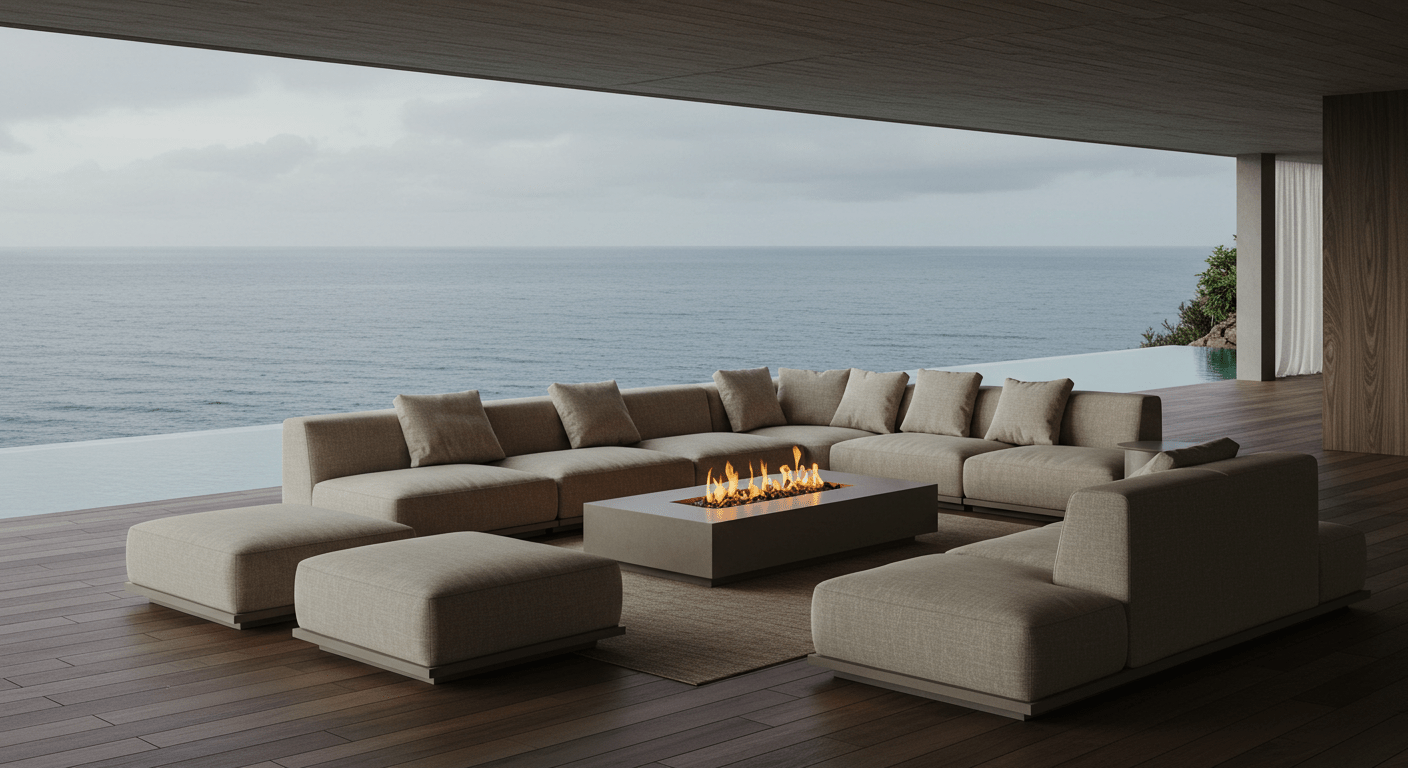
Fire pits serve as the anchor for patios and seating areas, providing 360-degree flame views that create natural gathering focal points. The concrete construction of luxury fire pits stays approximately 20 degrees cooler than steel, enhancing comfort during warmer months
The Role of Fire Pits in Creating Inviting Gatherings and Luxurious Ambiance
Fire pits extend outdoor living seasons, allowing for year-round use, even during cooler months. These fire features transform backyards into cozy retreats that differentiate properties in competitive markets. Particularly in regions with cooler evenings, fire pits provide warmth, ambiance, and memorable gathering spaces for friends and family
The Different Types of Luxury Outdoor Fire Pits
Luxury fire pits tables come in three primary fuel types—natural gas, propane, and ethanol—each offering distinct advantages for residential and commercial installations. Understanding construction styles, BTU outputs, and design features helps trade professionals specify the right system for each project.
What Are the Main Types of Fire Pits (Gas, Propane, Custom) for Luxury Settings?
Natural gas fire pits connect directly to home gas lines, providing unlimited fuel supply without tank refills. Propane fire pits offer portability and eliminate natural gas line installation requirements. Clean-burning ethanol options work for indoor/outdoor versatile applications where gas lines aren't available.
Built-in fire pits create permanent fixtures using stone, brick, or concrete materials. Portable units offer flexibility and lower upfront costs. In-ground fire pits deliver bonfire-style aesthetics, while above-ground installations direct heat better toward seated or standing occupants. Custom fabrications use Corten steel, aluminum, stainless steel, and powder coat finishes. Both natural gas and propane burners come with electronic or manual match-lit ignitions.
How Do Luxury Outdoor Fire Pits Differ from Standard Models?
Standard residential fire pits generally deliver 25,000 to 50,000 BTUs. In contrast, luxury models range from 150,000 to 300,000+ BTUs, making them suitable for both commercial and large residential applications. Premium units feature lifetime warranties on brass burners and offer better performance than mass-market models. Luxury fire pits also integrate unique features like log storage, convertible table functions, and custom design flexibility that standard models lack
What Are the Key Features of Luxury Fire Pit Tables and Designs?
Fire pit tables often feature multi-functional designs, such as converting into coffee tables, dining tables, or bar-height tables. The available shapes include rectangle, square, round, and custom fire bowls.
Material selections range from natural stone, marble, Dekton, Neolith, quartz, soapstone, concrete, and wood surfaces. Metal finishes can include 304 and 316 stainless steel, COR-TEN, 5052 aluminum, A36 steel, copper, and Monel alloys. Custom fire tables feature precision-engineered burners, seamless tops, and hidden propane tanks
Step-by-Step Guide: Safe and Efficient Installation of Luxury Fire Pits
Professional fire pit installation requires strict adherence to clearance codes, manufacturer specifications, and safety protocols. This seven-step process ensures code compliance, warranty qualification, and long-term performance.
Step 1: Verify Clearance Requirements and Code Compliance
Confirm the fire pit location maintains clearance from structures or combustible materials, as required by local codes. According to Cooke's instructions, the following clearances must be adhered to:
- Side Walls: Maintain at least 36 inches clearance from any combustible materials or structures.
-
Ceiling Clearance: Ensure the fire pit is at least 8 feet below any overhead surfaces.
- Flooring: The unit can be installed on a variety of surfaces such as concrete slabs, wood decks, or other level flooring types.
Additional clearance guidelines:
- Minimum Clearance to Combustibles: 36 inches from the side walls and 8 feet from the ceiling. Ensure that there is no flammable material above the fire pit during operation.
This update ensures that your fire pit is installed according to safety standards and complies with the necessary regulations.
Step 2: Engage Licensed Gas Professionals
Hire licensed gas professionals for all gas line connections and installations. Verify licensing ensures safety compliance and qualifies the installation for manufacturer warranty coverage. Confirm installer familiarity with local codes and regulations specific to your jurisdiction before work begins.
Step 3: Prepare the Installation Site
Position fire pit on flat, level surface for stability and safety compliance. Ensure base consists of non-combustible materials—concrete, stone, or fire-rated pavers. Verify surface can support the weight of fire pit structure and surrounding features.
Step 4: Position Burner Pan at Correct Depth
Install burner pan at proper depth of 3-5 inches below fire pit rim. Confirm depth allows adequate space for fire media while maintaining proper flame presentation. Ensure burner positioning allows for optimal gas distribution and flame pattern.
Step 5: Implement Safety Protocols During Installation
Ensure windows, doors, and building openings within 25 feet of fire pit location can be closed during operation. Verify adequate ventilation pathways for safe gas dispersion. Keep installation area clear of flammable materials throughout the installation process.
Step 6: Follow All Manufacturer Installation Instructions
Adhere strictly to manufacturer's installation manual for specific model requirements. Follow proper sequence for gas line connections, burner installation, and media placement. Document installation steps to ensure warranty qualification and future reference.
Step 7: Final Safety Verification
Conduct comprehensive leak test on all gas connections before first use. Verify all clearances meet or exceed local code requirements. Confirm proper flame operation and height adjustment functionality. Obtain required inspections and final permits as mandated by local authorities.
What Are the Necessary Tools and Materials for Professional Fire Pit Installation?
Essential tools include pipe cutter or hacksaw, metal file, pipe wrench, shovel, level, and safety gear. Required materials include fire-resistant bricks or stones, gravel, sand, and gas-rated Teflon tape or pipe dope. A ¾-inch key valve controls gas supply and flame height adjustment in most installations. Flexible gas line—typically ¾-inch x 36-inch—connects key valve to burner. Standard ¾-inch flex line carries up to 255,000 BTUs; larger burners require dual flex line kits. Compression fittings or transition fittings connect PE pipe to fire pit and gas supply.
Lava rock fills the base layer to 3-inch depth for drainage and heat distribution. Fire glass tops the lava rock at 2-inch depth. Fire glass averages $5.15 per pound for ½-inch size; lava rock costs $2.60 per pound. Whistle-free flex lines prevent loud noise during large volume fuel flow—standard lines create oscillation whistling that disrupts operation.
How to Safely Connect Gas Lines and Ensure Proper Ventilation?
Most residential fire pits use ¾-inch gas line. Larger burners with higher BTU outputs require larger lines—¾-inch at 60 feet supplies maximum 138,000 BTUs; 1-inch at 125 feet delivers 175,000 BTUs. Gas line trenching depth must reach 12-24 inches following local code requirements. Natural gas supply pressure runs minimum 6.0 inches W.C., maximum 7.0 inches W.C. LP gas requires minimum 8.0 inches W.C., maximum 11.0 inches W.C. Normal household natural gas operates at 7 inches W.C. (about ¼ PSI)—27.7 inches of water column equals 1 PSI pressure.
Proper ventilation on at least two sides prevents dangerous gas accumulation. All vents must remain open and clear, inside and out, for safe operation. Secure all gas connections leak-free using gas-rated Teflon tape or pipe dope on threads.
What Are the Key Installation Guidelines for Commercial and Residential Projects?
Professional fire pit installation costs $1,500 to $5,000 for basic projects. Elaborate custom fire pits with high-end materials can run $3,000 to $5,000 or more. The national average installation cost is $850 across all types. Commercial fire pits in hospitality settings must meet stricter fire protection codes than residential applications. Building permits are required for permanent gas line installations in most jurisdictions.
Fire pits should occupy no more than one-third of patio size for proper spatial planning. For example, on a 15x15 foot patio, fire pit width should not exceed 50 inches. Leave at least 6-7 feet of open space around the fire pit for safety and comfort.
For installation, ensure the following minimum clearances:
-
Side walls: 36 inches clearance from each side of the fire pit burner.
-
Ceiling: 8 feet clearance from the fire pit burner.
- Flooring: The unit may be installed on concrete slabs, wood decks, or other level surfaces
Addressing Common Installation Challenges in Luxury Fire Pit Projects
Installation challenges range from gas leaks and component failures to environmental factors affecting performance. Understanding common issues and proven troubleshooting methods prevents callbacks, ensures safety compliance, and protects warranty coverage.
What Are the Most Common Installation Issues and How to Avoid Them?
Cross-threaded flared fittings cause gas leaks that appear tight but aren't secure—verify proper thread engagement before final tightening. Propane gas settles at pit bottom; natural gas rises—both create explosion hazards requiring proper ventilation. Incorrect piping from gas stub to key valve commonly causes leaks. Air pockets in gas lines prevent smooth propane flow and require bleeding. Moisture in lines creates mild whistling or gurgling until evaporation. Standard yellow flex lines whistle loudly when turned up—whistle-free lines prevent this issue.
Wet lava rock explodes when heated if not fully dry before use. Thermal shock breaks tempered glass barriers during sub-zero to high temperature transitions—never operate glass-enclosed pits in deep winter. Spider nests in air mixers and burner ports block gas flow and prevent ignition—inspect and clean seasonally. Wind interferes with gas flow and oxygen supply—install wind guards in exposed locations.
How Do You Tackle Gas Line or Ignition System Troubleshooting?
Use soapy water solution to check for gas leaks—bubbles indicate leak location. Pressure test gas lines at 10-15 psi for 24 hours minimum to ensure no pressure drops. Check all valves are fully opened; replace hard-to-turn or damaged valves immediately. Remove electronic ignition batteries before winter to prevent corrosion. Battery-operated igniters use standard AA batteries for easy replacement. Clean igniter electrode with cloth to clear debris preventing spark generation.
Push button ignition creates spark after manually turning gas to low position. Thermocouple safety devices shut off gas when pilot light extinguishes or irregularities occur. Blocked or broken burners cause poor gas flow and uneven flames—inspect ports and replace damaged components. Perform annual leak checks on all gas connections, joints, and appliance piping as preventive maintenance.
What Are the Key Safety Concerns During Fire Pit Installation?
Gas fire pits pose serious hazards requiring CSA and ANSI certified testing by accredited laboratories. Insurance companies deny claims for fire-related damages from non-certified appliances—specify only certified units. Licensed professionals are required for gas piping installation to ensure warranty qualification and safety compliance. Prohibit fire during burn bans, red flag days, or when winds reach 10 mph or higher. Burning is prohibited when predicted sustained winds exceed 20 MPH per fire official determination.
Propane tanks must stay at least 5 feet from house structures. Propane becomes liquid and useless below -44°F—consider climate when specifying fuel type. Keep fire extinguisher, garden hose, or bucket of dry sand nearby during use. Fire pits require days to cool after extinguishment—dispose of ash properly in metal buckets only. Schedule regular inspections twice yearly by licensed professionals to maintain safety and performance standards.
Maintenance and Troubleshooting for Long-Term Fire Pit Performance
Proper maintenance extends fire pit lifespan, ensures safety compliance, and protects warranty coverage. Regular cleaning, seasonal inspections, and prompt troubleshooting prevent costly repairs and maintain optimal performance throughout the fire pit's service life.
How to Maintain Your Luxury Outdoor Fire Pit for Optimal Performance?
Clean fire pit at least once yearly before storing or covering for winter. In damp climates, clean 2-3 times per year minimum. Heavy use requires 3-4 cleanings annually or more as needed. Always clean after exposure to rain, sprinklers, or storms to prevent moisture damage.
Clean fire glass with 50/50 water and vinegar solution using stainless steel mesh strainer. Rinse lava rock with water and spread out to fully air dry before reinstalling. Remove all media to clean burner and inner basin thoroughly. Use soft cloth, plastic brush, or sponge with mild soap and water to remove buildup. Scrub away carbon deposits and soot from burner components. Inspect hoses seasonally for damage from temperature fluctuations or gnawing rodents.
What Are the Best Practices for Troubleshooting Fire Pit Issues?
Check propane tank is full and properly connected with valve in open position. Open tank valve before fire pit valve to prevent safety check valve engagement. Inspect and clean air mixer—spiders frequently nest in this component. Unscrew mixer from tank hose and burner for full access to check for insects. Clean mixer holes by washing in warm soapy water or running toothpick through each opening.
Inspect blocked or broken burners and remove debris from ports causing blockage. Look for cracks or damage to burner causing inconsistent gas flow. Tighten all connections at thermocouple and gas valve without overtightening. Wrong size regulator on supply line results in excess gas and whistling sounds. Bends in flexible lines also cause whistling—straighten or replace as needed.
How to Ensure Longevity and Durability for Luxury Fire Pits?
Cover fire pit when not in use to prevent damage from daily element exposure. Wait until completely cool before covering to prevent melting. Soft covers—cloth, nylon, vinyl—trap moisture and void warranties for resulting damage. Store portable fire pits away during winter or off-season for harsh weather protection. Store glass barriers indoors during winter to prevent thermal shock cracking.
Schedule regular inspections twice yearly to maintain safety, performance, and longevity. Keep fire at lower heat settings during windy conditions to reduce concrete charring and cracking. Apply metal protectant regularly to cast iron or steel fire pits preventing rust. Freshen stainless steel pans by liberally applying vinegar, letting sit 10 minutes, then rubbing with soft cloth. Concrete fire pits can be refinished by homeowners using manufacturer's refinishing kits.
Selecting the Right Supplier for Your Luxury Outdoor Fire Pit Project
Supplier selection determines project success, warranty protection, and long-term performance reliability. Trade professionals must evaluate certifications, technical support capabilities, and reputation before specifying fire pit systems for residential or commercial installations.
What Criteria Should Be Used to Choose the Right Supplier for Luxury Fire Pits?
Verify that the supplier offers American-made fire pit components that are engineered with higher performance standards than imports. The supplier should provide detailed product dimensions, material specifications, and installation guidelines. They should also offer comprehensive technical resources and installation support materials.
Make sure the supplier offers lifetime warranties on key components such as brass burners. Additionally, confirm that they have qualified technical support, including access to NFI certified technicians for training and troubleshooting.
While CSA/ANSI Z21.97-2017 certification is important for safety, it is not required in all cases—ensure the supplier provides reliable safety and quality testing for their products. Suppliers should also provide clear documentation and BIM content for professional designers
Why Supplier Reputation and Support Matter in Luxury Fire Pit Installations?
Reputable suppliers stand behind quality with 50-year to 100-year structural integrity warranties. Carbon steel fire pits typically include 10-year warranties; stainless steel offers up to 100-year warranties. Established suppliers provide ongoing testing to maintain certifications and safety standards. Factories receive regular visits by 3rd party inspectors ensuring no substitutions to approved critical parts.
Quality suppliers offer hassle-free lifetime burner warranties replacing cracked or broken burners. So-Cal Fire Pits provides commercial-grade performance standards for luxury outdoor fire pit installations. Reputable suppliers offer return merchandise authorization processes for defective products. Established companies provide responsive customer service and technical troubleshooting support. Industry-leading suppliers maintain relationships with licensed installers and professionals. Premium suppliers offer complete gas kits with all necessary components for safe efficient connection.
How Can You Ensure Reliable Technical Guidance and Support from Your Supplier?
Suppliers should provide detailed installation manuals and step-by-step guides. Access to technical support hotlines staffed by NFI certified technicians is essential. Video tutorials should cover valve priming, component connection, and troubleshooting. Online training opportunities and in-person training sessions serve design professionals.
Suppliers should offer free fire pit guides packed with knowledge and best practices. Technical consultation must be available for gas line sizing calculations and pressure requirements. Troubleshooting support addresses issues like whistling, flame height, and ignition problems. Suppliers provide master reference guides with common dimensions and helpful installation information. Access to BIM content and exclusive technical resources supports architects and builders. Responsive support teams remain available to consult with installers during the installation process.
Ready to Elevate Your Next Fire Pit Project?
Partner with So-Cal Fire Pits for premium luxury outdoor fire pit solutions backed by expert technical support and certified safety standards.
Whether you're specifying a luxury modern fire pit table for hotels or designing fire features for high-end residential estates, our team delivers the expertise your projects demand. We provide architectural-grade materials, technical guidance, and precision-engineered components that ensure code compliance, warranty qualification, and lasting performance. From custom design consultations through white-glove installation support, we partner with architects and designers who refuse to compromise on commercial-grade quality.
Contact So-Cal Fire Pits today to discuss your project requirements, access detailed specifications, and discover how professional-grade fire pit systems create lasting value for your clients while maximizing your project profitability and minimizing callbacks.




.%20These%20del...)